Educate your employees, customers, and industry partners on the signs and impact of human trafficking in Iowa.
Understanding the Issue
What is Human Trafficking?
Human trafficking involves the use of force, fraud, or coercion to obtain some type of labor or commercial sex act. (Source: Homeland Security)
Who Are the Victims?
Human trafficking victims can be of any age, race, sex, ethnicity, nationality, immigration status, and socioeconomic class. In many cases, victims do not come forward or seek help because they are vulnerable, potential language barriers may exist, they have a fear of law enforcement, or they do not believe they identify as a victim.
Vulnerabilities Traffickers Exploit:
Children:
- Lack of safety at home from violence, abuse, and neglect
- Homelessness or runaway status
- Lack of proper care in the child welfare system
Adults and Children:
- Lack of trust in government institutions
- Economic hardship
- Isolation from family and/or community
- Displacement from natural disasters
High-Risk Individuals
Individuals with the following vulnerabilities are at heightened risk for trafficking:
- Unstable Living Conditions – Homelessness, housing insecurity, frequent moves
- History of Domestic Violence – Past or current abusive relationships
- Caregiver/Family Member with Substance Abuse Issues – Household instability due to addiction
- Runaways or Involvement in Juvenile Justice/Foster Care System – Youth lacking stable support systems
- Undocumented Immigration Status – Fear of deportation, limited legal protections
- Poverty or Economic Need – Financial desperation, unemployment
- History of Sexual Abuse – Previous trauma and exploitation
- Addiction to Drugs or Alcohol – Substance dependency used as a control mechanism
Types of Human Trafficking
The United States recognizes two primary forms of trafficking in persons:
Sex Trafficking
Sex trafficking encompasses the range of activities involved when a trafficker uses force, fraud, or coercion to compel another person to engage in a commercial sex act or causes a child to engage in a commercial sex act. (Source: Understanding Human Trafficking – United States Department of State)
Common Locations:
- Private homes
- Massage parlors
- Hotels
- Brothels
- Online/Internet platforms
Common Coercion Methods:
- Threats of serious harm
- Psychological harm
- Reputational harm
- Threats to others
- Debt manipulation
Important Note: Every case in which a child (younger than 18) is involved in any of the aforementioned acts is considered trafficking, regardless of the method or whether evidence of force, fraud, or coercion exists. The use of children in commercial sex acts is prohibited by law in the United States and most countries around the world.
Forced Labor
Also referred to as labor trafficking, forced labor encompasses a range of activities involved when a person uses force, fraud, or coercion to exploit the labor or services of another person.
Common Coercive Schemes:
- Threats of force
- Debt manipulation
- Withholding of pay
- Confiscation of identity documents
- Psychological coercion
- Reputational harm
- Manipulation of the use of addictive substances
- Threats to other people
Forced labor can occur in any sector or setting. Common locations include:
- Agricultural fields
- Factories
- Restaurants
- Hotels
- Massage parlors
- Retail stores
- Fishing vessels
- Mines
- Private homes
- Drug trafficking operations
Common Warning Signs
Traffickers often operate under the disguise of a legitimate business or relationship, making it challenging to recognize their true intentions. They adapt their tactics to exploit modern technology and social media, targeting individuals through online platforms and personal networks. Communities may not always be aware of the signs or the presence of trafficking within their midst, which makes public education and awareness crucial.
Recruitment Methods Often Used by Traffickers:
- Violence
- Manipulation
- False promises of well-paying jobs
- Romantic relationships (also known as “Romeo pimping”)
Key Indicators of Human Trafficking
Important: Not all indicators listed below are present in every human trafficking case, and the presence or absence of any of these indicators is not necessarily proof of human trafficking.
Social Isolation
- Does the person appear disconnected from family, friends, community organizations, or houses of worship?
- Has a child stopped attending school?
Behavioral Changes
- Has the person had a sudden or dramatic change in behavior?
- Is a juvenile engaged in commercial sex acts?
- Is the person disoriented or confused, or showing signs of mental or physical abuse?
Physical Signs
- Does the person have bruises in various stages of healing?
- Does the person show signs of having been denied food, water, sleep, or medical care?
Signs of Control
- Is the person fearful, timid, or submissive?
- Is the person often in the company of someone to whom he or she defers?
- Is someone controlling where they go or who they talk to?
- Does the person appear to be coached on what to say?
Living Conditions
- Is the person living in unsuitable conditions?
- Does the person lack personal possessions and appear not to have a stable living situation?
- Does the person have freedom of movement?
- Can the person freely leave where they live?
- Are there unreasonable security measures?
Human Trafficking 101 Information Sheet
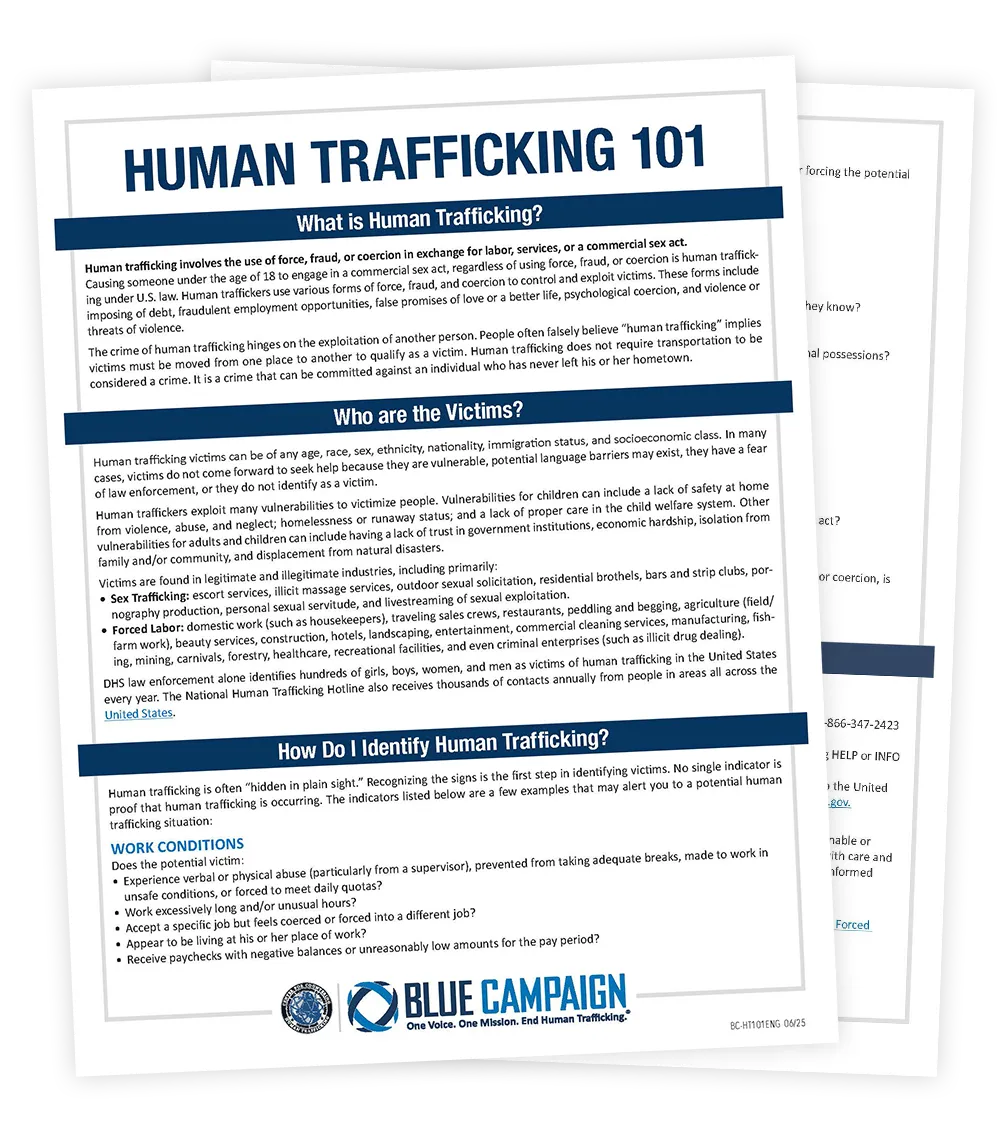
Published by the U.S. Department of Homeland Security’s Blue Campaign
Legal Framework
Federal Legislation: The Trafficking Victims Protection Act of 2000 (TVPA) and its subsequent reauthorizations recognize and define two primary forms of human trafficking:
Sex Trafficking Definition (22 U.S.C. § 7102(11)(A))
The recruitment, harboring, transportation, provision, obtaining, patronizing, or soliciting of a person for the purpose of a commercial sex act in which a commercial sex act is induced by force, fraud, or coercion, or in which the person induced to perform such act has not attained 18 years of age.
Forced Labor Definition (22 U.S.C. § 7102(11)(B))
The recruitment, harboring, transportation, provision, or obtaining of a person for labor or services, through the use of force, fraud, or coercion for the purpose of subjection to involuntary servitude, peonage, debt bondage, or slavery.
Additional Legal Definitions:
- 18 U.S.C. Chapter 77 (criminal definitions)
- 19 U.S.C. § 1307 (includes definition of “forced labor” for purposes of implementing the federal prohibition on importation of goods produced with forced labor)
Resources:
Trafficking in Iowa
Iowa’s Statistics
Iowa Network Against Human Trafficking and Slavery
Iowa NAHT is a statewide coalition dedicated to ending human trafficking through prevention, intervention, and advocacy.
National Human Trafficking Hotline
The National Human Trafficking Hotline operates 24/7 and collects data from calls, texts, and online reports to track trafficking trends.
Iowa Coalition Against Domestic Violence
The ICADV represents 23 local crime victim service providers, supporting survivors in all 99 counties.

